Most arguments between couples and photographers are not about the photos. They are about what was promised: how many edited photos, when the album comes, whether the mehendi was included, and what happens to the advance if the date moves. A short written contract settles those questions before the wedding, while everyone is still happy.
This guide lists what a wedding photography contract in India should cover, gives you a format to copy, and shows how to get it accepted without printing anything.
Note
This is a practical checklist based on how studios work, not legal advice. For a large shoot or a dispute, talk to a lawyer in your state.
Quotation or contract: do you need both?
A quotation says what you will shoot and what it costs. A contract adds the rules around it: when money is due, when work is delivered, and what happens if plans change. Many studios in India combine the two: the quotation carries the package and the price, and a terms section under it carries the contract. That works well, as long as the client clearly accepts both.
If you are still building your quotation, start with our photography quotation format.
12 things every wedding photography contract should cover
- Who and when. The studio's name, the couple's names and phone numbers, and every function with its date, time and venue: haldi, mehendi, sangeet, wedding, reception.
- Coverage. How many photographers and videographers, for how many hours each day, and whether a drone, a candid photographer or a second shooter is included.
- Deliverables. The approximate number of edited photos, the films and their length, the album (sheets and size), any e-album, and live photo sharing for guests if you offer it.
- RAW and unedited files. Say clearly whether you hand them over. Many studios don't, or charge extra for them. Write it down either way.
- Delivery dates. A sneak peek, all edited photos, the film and the album, each as "within N weeks of the wedding" or "within N weeks of album selection".
- Album selection and changes. How the couple picks photos for the album, how many rounds of design changes are included, and that the album's delivery time starts when the selection comes back.
- Payment schedule. The advance at booking, the next payment before the first function and the balance before the album is delivered; how they pay (UPI or bank transfer); and that every payment gets a receipt.
- Travel, stay and food. Who pays for travel and stay outside your city, and meals for the team on long days.
- Extra hours and extra functions. The rate for overtime and for a function added later, so nobody argues on the day.
- Cancellation and date changes. What happens to the advance if the couple cancels or moves the date, and what you do if you cannot attend (a replacement photographer or a refund).
- Photo use and privacy. Whether you may post the photos on Instagram and your website, and how guests' photos and selfies are handled: who can see them and for how long.
- Storage and limits. How long you keep the files after delivery, and a fair limit on your liability (for example, up to the amount paid) if a memory card fails despite your backups.
A simple format you can copy
Keep it to one or two pages, in plain words the family can read. A layout that works:
- Studio: name, address, phone. Client: the couple's names and phones.
- Events: function, date, time and venue, one line each.
- Package: name and price. Includes: team, hours, photos, films, album, e-album.
- Add-ons: drone, extra function, extra album, each with its price.
- Payments: advance to book; second payment and its date; balance before album delivery. A receipt for every payment.
- Delivery: edited photos within N weeks; film within N weeks; album within N weeks of album selection.
- Album: N rounds of design changes included; selection due within N days of receiving the photos.
- Changes: what happens on a date change; what happens to the advance on a cancellation.
- Use of photos: may or may not be shared on our website and social media.
- Files: kept for N months after delivery. Liability limited to the amount paid.
- Accepted by: name and date.
How to get it accepted without printing
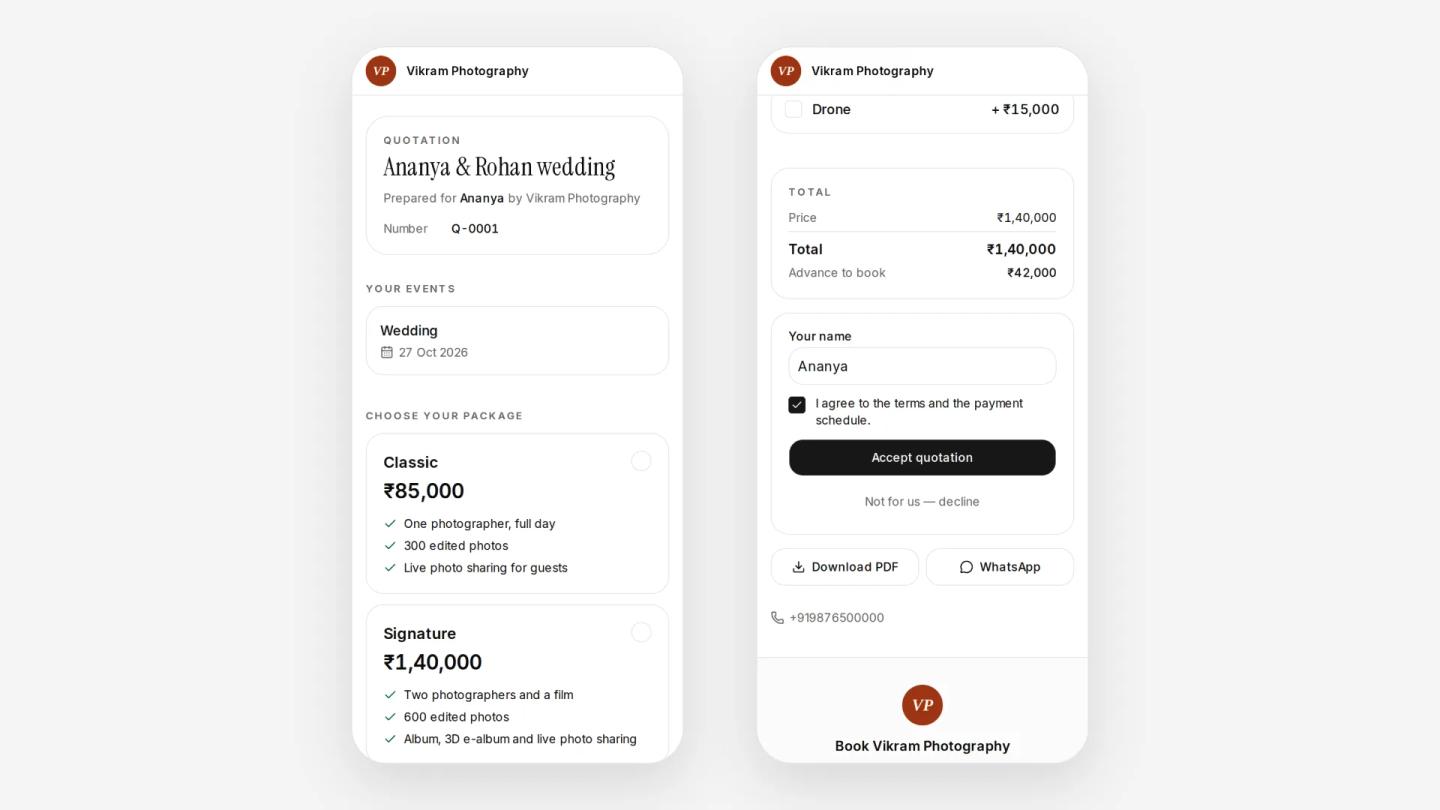
A signed paper copy is fine, but most couples today reply on WhatsApp. If you go that way, make the acceptance clear: send the full terms, not just the price, and ask for a written "I accept" or, better, an accept button that records the name and the date. Keep a copy of what they accepted, because quotations often change before the wedding.
Send the terms with the quotation, not after the advance. Asking for terms once money has moved feels like a trap to the family, and by then it is harder to change anything.
Tips from studios
- Put delivery dates in weeks, not "soon". Waiting months for the album is the complaint couples make most often.
- Add an album selection deadline. If the couple takes three months to choose, the album is three months late through no fault of yours.
- Write the advance and the cancellation rule next to each other, so nobody misreads them.
- Use the language your clients read. A Telugu, Hindi or Tamil copy next to the English one avoids misunderstandings.
- Look at your terms again every season: prices, travel costs and delivery times change.
Doing it in Photomitra
In Photomitra the quotation and the terms travel together. You set up your packages, add-ons and terms once; for each couple you pick them, add the functions with dates and venues, and send the link on WhatsApp. The family chooses a package, ticks "I agree to the terms and the payment schedule" and accepts on their phone, and you can see when they opened it.
After that, payments are recorded with receipts, the couple selects their album photos online, and they can follow the album's progress without calling you. See how it works in studio software.
Share this post
Written by the Photomitra teamWe build live photo delivery, album selection and studio software for wedding and event photographers in India, and set it up with them on WhatsApp. About us