The photos make the family happy. The invoice is what gets you paid. A clear invoice tells the person paying what they are paying for, how much has already come in and what is still due, so the balance doesn't drag on for months after the wedding.
This guide shows what a photography invoice in India should include, how GST fits in, a format you can copy, and how to handle the advance, the balance and receipts.
Note
This is a practical guide based on how studios work, not tax advice. GST rules change, so check with your CA before you file.
Quotation, invoice and receipt: three different papers
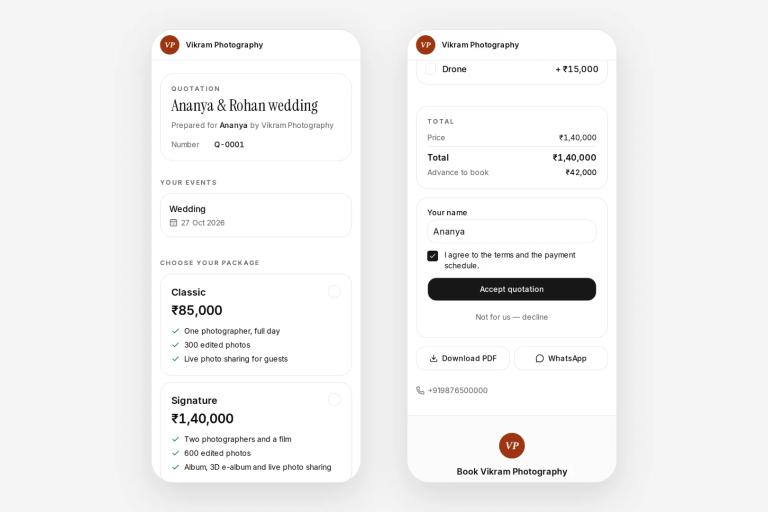
- Quotation: sent before booking. It lists the package and the price, and the family accepts it. If you don't have one yet, start with our photography quotation format.
- Invoice: the bill for the work. It says what was done, the amount, any tax, and what is still due.
- Receipt: proof that one payment came in, with the amount, the date and how it was paid (UPI, bank transfer or cash).
Most money arguments start when these get mixed up: a quotation PDF sent as the bill, or a ₹50,000 advance taken on UPI with nothing in writing. Keep the three separate and each one is easy to read.
What a photography invoice should include
- Your studio details. Studio name, address, phone and email, and your GSTIN if you are registered.
- Invoice number and date. A running number that never repeats in a financial year, for example AS/2026-27/014.
- Client details. Name, phone and address. For a corporate event, also the company's name and GSTIN.
- Event details. Each function with its date and venue: haldi, mehendi, sangeet, wedding, reception.
- Line items. Coverage (photographers, videographers, hours), the album, films, drone and extra prints, each with its own amount.
- SAC code. Event photography and videography services are commonly billed under SAC 998383.
- Tax. If you are registered: the taxable value, the GST rate, the tax amounts and the total.
- Payments so far and the balance. The advance with its date, any part payments, the balance due and its due date.
- How to pay. Your UPI ID or QR code, and bank details (account name, number and IFSC).
- One or two lines of terms. What the advance covers and when the album and files come, matching your contract.
GST on photography: the short version
Photography services in India are generally taxed at 18% GST. A service business usually has to register once its turnover crosses ₹20 lakh in a year (₹10 lakh in some special category states), and some situations need registration earlier. Your CA can tell you which applies to you.
- Registered studio: issue a tax invoice with your GSTIN, the SAC code and the tax split. Client in your state: 9% CGST + 9% SGST. Client in another state: 18% IGST.
- Not registered: don't charge GST and don't write a GSTIN. Your invoice is a plain bill with the amount.
- Corporate clients usually need your GSTIN and theirs on the invoice to claim input credit, so ask for their GSTIN before the event.
Watch out
Only charge GST if you are registered. Adding "GST 18%" to a bill without a GSTIN is wrong, and families do notice.
A worked example: a registered studio bills a ₹1,50,000 wedding package to a family in the same state. CGST at 9% is ₹13,500 and SGST at 9% is ₹13,500, so the total is ₹1,77,000. If a ₹50,000 advance came in on UPI, the balance due is ₹1,27,000.
A simple format you can copy
Keep it to one page. A layout that works:
- TAX INVOICE (or INVOICE if you are not registered), the invoice number and the date.
- From: studio name, address, phone, GSTIN.
- To: client name, phone, address (and GSTIN for a company).
- Events: function, date and venue, one line each.
- Items: coverage, album, films, add-ons, each with SAC 998383 and its amount.
- Totals: taxable value, CGST and SGST (or IGST), total.
- Paid: the advance with its date and mode. Balance due: the amount and the date.
- Pay by: UPI ID or QR code, bank details.
- Note: album delivered within N weeks of the album selection.
Advance, balance and receipts
Wedding money comes in parts. Put the plan on paper from the start, so nobody has to ask.
- An advance at booking to hold the date.
- A second payment before the first function.
- The balance before the album or the final files are delivered.
- A receipt for every payment, the same day, with the amount, the date, the mode and the balance left.
When a family pays ₹40,000 on UPI and hears nothing back, they remember it. A receipt sent within minutes builds trust and stops "we already paid that" arguments months later. The payment schedule itself belongs in your wedding photography contract.
Tips from studios
- Start a new invoice series each financial year (April to March).
- Send the invoice as a PDF on WhatsApp, not a photo of a paper bill. It is easy to forward to whoever pays.
- Make the balance and its due date bold. It is the line the family reads first.
- Ask for the client's GSTIN before a corporate event, not after it.
- Keep a copy of every invoice and receipt in one folder for your CA.
Doing it in Photomitra
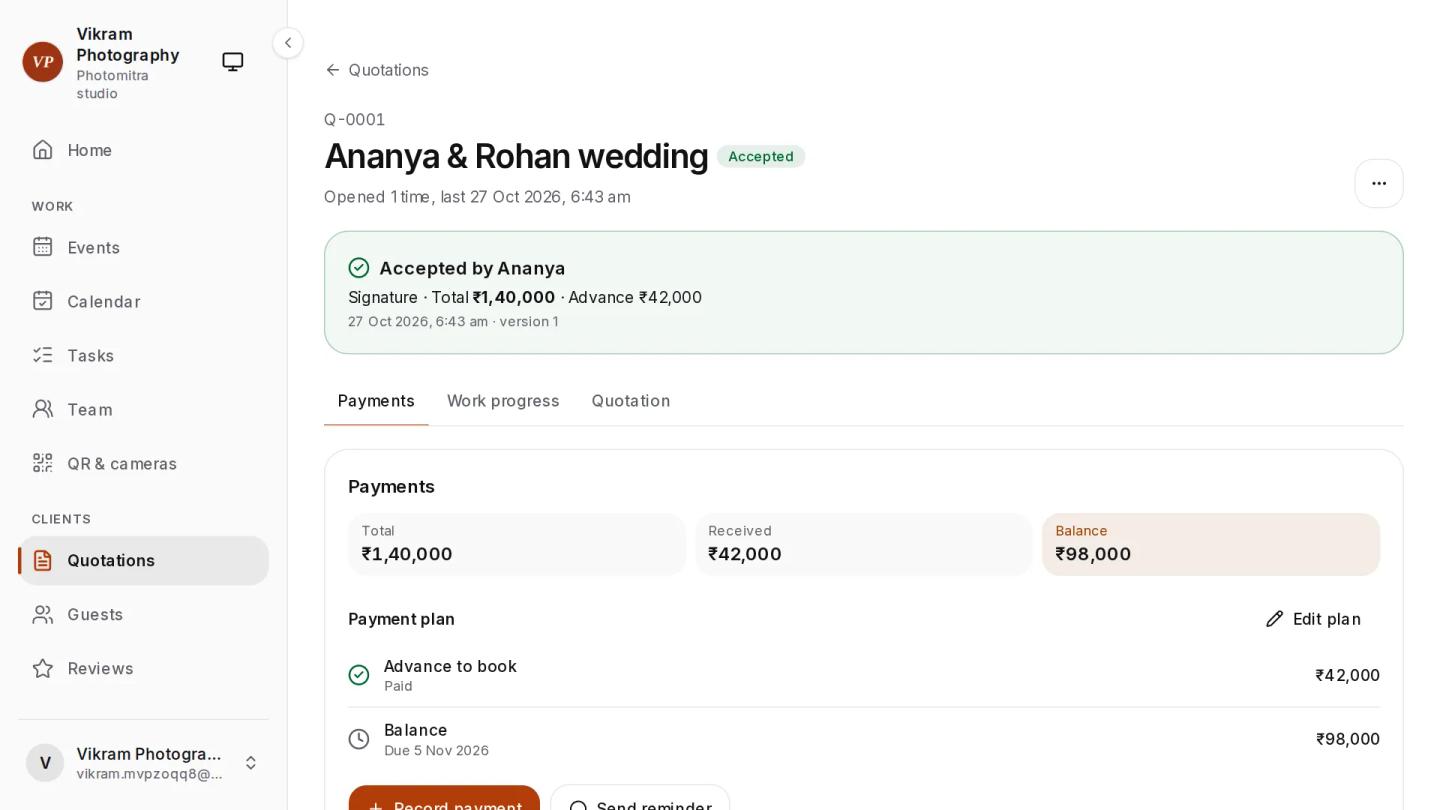
In Photomitra the money side follows the quotation. Once the couple accepts the quotation on their phone, you set a payment plan with instalments. When a UPI payment comes in, you record it, the client gets a receipt and the balance left updates. A WhatsApp reminder for the next instalment is a tap away.
Add your GSTIN once and your invoices become GST invoices. Clients don't need an account: quotations, receipts and progress pages open from the links you send. See how it works in studio software.
Share this post
Written by the Photomitra teamWe build live photo delivery, album selection and studio software for wedding and event photographers in India, and set it up with them on WhatsApp. About us